

And it’s been going great!
I can easily make edits, add new pages, it’s hosted for free, and it’s performing better than ever.
The Backstory
A couple of months ago, I mentioned on Threads how I had used ChatGPT (and later Claude) to help me create a WordPress theme for a site. Someone asked why I didn’t just use Claude for the whole site.
I didn’t know what they meant, but it sounded interesting. So I did some digging. After a couple of Google searches, I turned to Claude to see what was possible. It gave me the full rundown of how it would work and how I could host it for free.
I have been building sites with WordPress since 2007. I taught myself the basics of WP over the Fourth of July weekend that year because I was the Art Director/lead developer for a small agency, and websites were becoming a bigger part of the business. Since I’m always interested in what technology is next, I knew it was time to move away from HTML/CSS sites and figure out how to use and customize a CMS. I’ve also led sites built on Drupal and Craft, but most of my experience has been with WP.
Now that it’s 2026 and everything is AI, it was time to explore this option.
I had already built Aeto on WordPress with a Claude-coded theme. But I wanted to redesign it, and this gave me the excuse to try new technology, hoping it would achieve my real goal: updating the site faster.
The System
When Claude said it could set up the site so it goes from local to GitHub to Cloudflare Pages, I was stunned that I could host this site for free.
(BTW, if you need to register domains, use Cloudflare. It’s the least expensive option, and it’s so easy to work with the DNS. No affiliate link or anything. Just use it.)
The Benefits
I can make edits so fast and easily. It’s easier to test everything because I no longer have to worry about the appearance parts of my site living separately from the database parts of my site.
I can write a blog post, describe images, note where subheads or callouts live, and then I just give that information (along with the folder containing the images) to Claude. It builds the page. I don’t have to futz around with dragging blocks onto my page. Paragraph block (copy/paste), image block (upload image), headline block (copy/paste), paragraph block (copy/paste), callout block (copy/paste), paragraph block (copy/paste), and so on.
I just give the information to Claude, and it builds the page. I can preview it on my local, and then deploy it when I’m ready. 30 seconds later, it’s live on my site.
I even added an automatic branded overlay to all photos so it would cover any watermarks from stock photos created in Gemini, though it no longer watersmarks images.
When I recently added a Chrome Extension, I just asked Claude Code where to add it. It suggested the pages and paragraphs, and after a couple of rounds, it added the copy and links to the correct pages.
The Downfalls
As I mentioned, I’ve been using WordPress for nearly twenty years. I had a set of plugins that I automatically installed whenever I built a site. Now I have to ensure that functionality is included in Google Tag Manager, or have Claude Code add it directly.
The lack of a back-end interface takes a little while to get used to. But now, I just ask Claude questions when I’m wondering about something on the site.
This Isn’t For Everyone
If you haven’t built a site before, I don’t suggest you run out and have Claude Code and Claude Design create a website for you. It might look good, but there could be serious problems you don’t understand. You have to ensure that it’s accessible. And you have the right cookie compliance in place. It’s most likely responsive, but you have to double-check that. Is it set up for SEO/AEO/GEO? Does it have a sitemap that can be submitted to Google and Bing? These are all aspects that I know to look for because I’ve been doing this for a while.
I’ve probably built 60 sites since my first site in 2002. And I’ve worked with many very talented digital experience professionals, so I know a site is so much more than how it looks.
Yes, using AI for something like this is easy … but unless you know the hard way of doing it, you have a lot riding on a tool that can easily steer you wrong.
Challenges
I have a section in the Aeto app that iFrames a page from the website into the interface. The idea is to have a help page that can be easily updated on the web side without me needing to deploy a brand-new version of the app.
When I launched my new site, that iFrame stopped working. I had Claude Code sessions running for both my app and website, and they were blaming each other. It was just like working with real-world developers!
Luckily, I’ve managed a lot of developers over the years, and I knew which questions to ask to get around the stubbornness that can sometimes arise.
And just like a human developer, Claude Code can take you down the wrong path sometimes. I lost 90 minutes yesterday trying to get something to work on my site. When I can’t get past a problem, I’ll bring in a new point of view by asking regular Claude or Gemini to assess the problem and give solutions.
And sometimes I just have to look at the code, see what’s wrong, and explicitly tell Claude what to fix.
The Fun Stuff
One thing I implemented recently was a result of a book I was reading. I just finished Donald Miller’s How to Grow Your Small Business.
In it, Miller discusses his Storybrand methodology and explains how everything on your website should fit within a 7-part framework. I asked Claude about this, and it built in a tool that lets me evaluate any page on my site to review my copy and make sure there’s no fluff cluttering up the page.
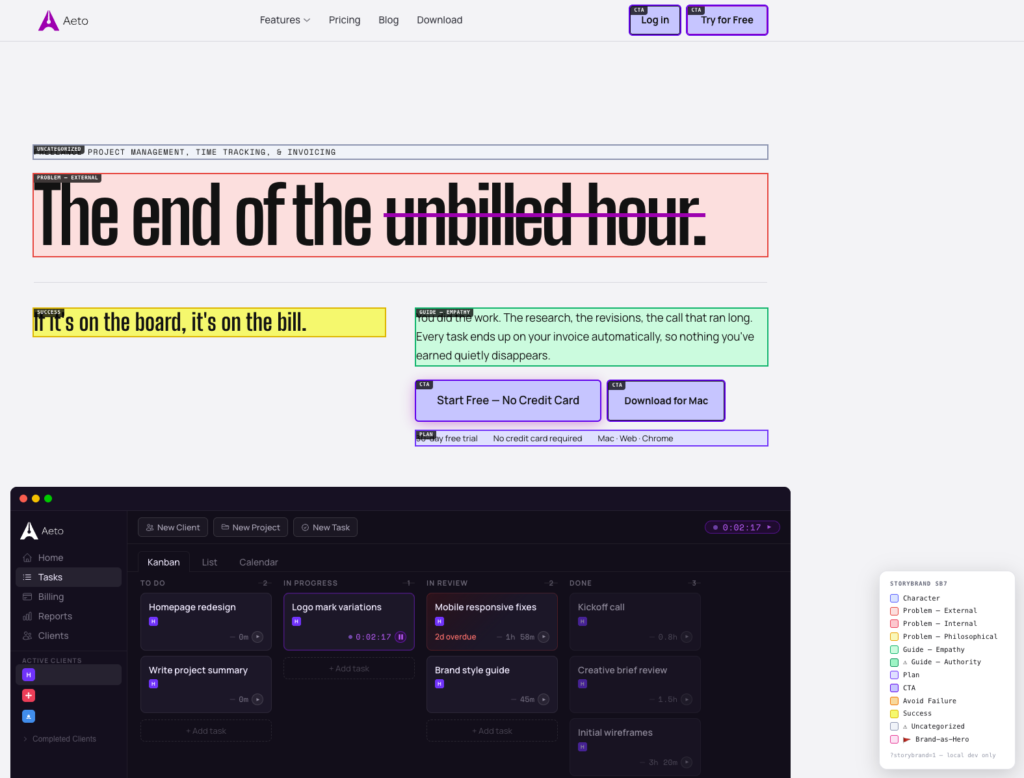
It helped me identify some areas of the site that needed clarification, removal, or fleshing out.
The Payoff
It’s working really well. I’m able to easily edit multiple places within my website with minimal overhead of remembering every block on every page at all times. I can add features, like the StoryBrand review, and have Claude give real-time feedback.
This wouldn’t work for an enterprise website with multiple contributors (you need a CMS for that), but it works for a site where I am doing everything myself. What used to be a full-time job for a few people is now something I’m doing an hour or two a week.
This post originally appeared in the Marketing by Design newsletter.